Building Canada’s next chapter at Catalyst Convene Canada 2026
5 min read
| Published on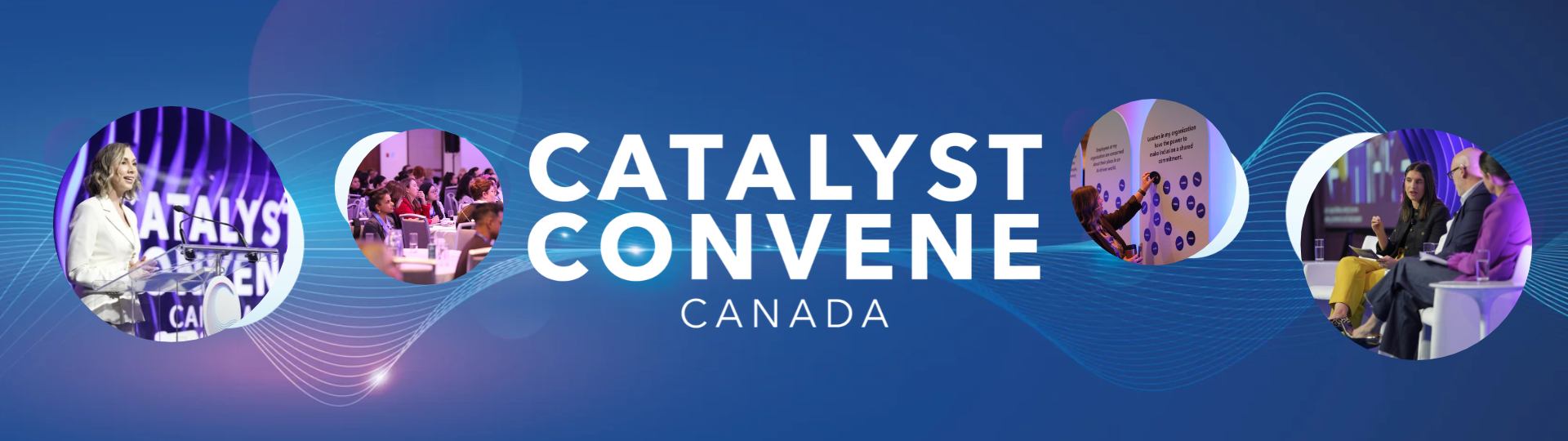
The opportunity ahead for Canada is enormous. So is the talent challenge.
Onstage at Catalyst Convene Canada, Julie Vaux, Catalyst Canada’s Executive Director, put the question on the table: As investment flows into energy, critical minerals, infrastructure, defence, and AI, who will lead Canada into a more competitive future? As nearly half the workforce, women are central to the answer.
On 21 October 2026, more than 690 business leaders from 140+ organizations gathered in Toronto and online for a day spanning AI, accessibility, reconciliation, sponsorship, gender partnership, and women’s advancement. Under the theme of Illuminate, the invitation was not simply to see workplace barriers more clearly. It was to decide what we do with what we see.
The 2026 Catalyst Champions showed what that looks like in practice, turning conviction into decisions about who gets hired and promoted, how performance is measured, and who gets career-changing opportunities.
Or, as Catalyst President & CEO Jennifer McCollum put it: “Evidence does not change a company. People do.”
Four takeaways from Catalyst Convene Canada:
1. Canada cannot build its future without women.
Canada’s talent challenge isn’t simply about finding enough people. It’s about making full use of the talent already here.
That thread ran from Julie Vaux’s opening challenge through Building the Talent Bench: How Leading Organizations Attract, Keep, and Promote Women, where Heather Tobin, Senior Managing Director and Global Head of Capital Markets at CPP Investments, focused attention across the full talent lifecycle, from recruitment and onboarding through development, sponsorship, retention, and leadership.
The question, then, is bigger than representation: Do organizations have the conditions that enable women to stay, grow, and lead? That means looking beyond recruitment to development and sponsorship, workplace flexibility and benefits, and health supports that reflect women’s needs across different life stages.
The workforce Canada needs next will depend on unlocking more of women’s talent and leadership.
2. AI is creating opportunity. Leaders will determine who benefits.
AI promises to change what people do at work and how they do it. Convene pushed it one step further: Who will benefit?
In The Next Great Leap: How AI Could Be the Biggest Catalyst for Women’s Advancement, Jennifer McCollum and Linda Hasenfratz, Executive Chair of the Board at Linamar, explored AI’s potential to reduce barriers, accelerate skill development, and open access to higher-value roles for women. The session also put responsibility squarely on leaders: disruption alone does not determine the outcome. Decisions about skills, mobility, and access do.
New Catalyst research added urgency—among more than 1,500 women using AI at work in Canada and the United States, 73% use it at least weekly and nearly 70% say it has improved their work. Yet women described a new version of the double bind: being perceived as less credible if they use AI, but less capable if they don’t.
The leadership question is no longer simply whether organizations adopt AI. It’s whether they create the conditions for women to benefit equally from its opportunities for growth and advancement.
3. The future workforce is built through pathways, not promises.
Across several sessions, a common question surfaced: Who actually has access to opportunity?
In Beyond Accommodation: Building Workplaces Where People with Disabilities Thrive, leaders moved the conversation beyond one-off accommodations toward systems change, including who gets access to stretch assignments, high-visibility projects, and paths to promotion.
The Opportunity Multiplier: How Leaders Create Access, Advocacy, and Advancement through Mentorship & Sponsorship carried that idea into career progression, distinguishing guidance from the influence and access sponsorship can provide.
The day’s closing panel, The Future Workforce: Building Inclusive Talent Pathways in a Time of Disruption, widened the lens. David Morgenstern, President of Accenture Canada, Karalee Close of Accenture, Paul Clark of TD Bank, and Nadim Kara of GreenShield explored how AI, evolving skills, new career pathways, and changing workforce expectations are reshaping talent strategy. The conversation underscored the challenge: how can organizations remain competitive while ensuring opportunity keeps pace with change?
Different issues, same leadership challenge—being present in an organization does not automatically mean having a path through it. If people are going to stay, grow, and lead through disruption, talent pathways need to evolve alongside the work itself.
4. Progress happens when we share responsibility.
Creating those pathways cannot fall solely to the people trying to navigate them.
That idea came to life in Hydro One’s The Allyship Circle: Building Psychological Safety Together, which reframed allyship as a circle of responsibility rather than a top-down hierarchy, drawing on insights from Hydro One’s frontline experience.
It continued in Shared Responsibility, Stronger Business: Why Inclusion Requires Everyone, where Laurie Henneborn, Catalyst’s Vice President of Research, Insights & Solutions, Abhishek Sarathy of Canadian Tire Corporation, and Zabeen Hiriji, Founder of Purposeful Third Act Movement, explored gender partnership—when people of all genders take shared responsibility and mutual accountability for advancing gender equity and inclusion.
Gender partnership makes advancing progress everyone’s work. Catalyst’s thought leadership shows what that can mean for organizations: employees whose managers demonstrate gender partnership behaviours (the "5 B’s") are eight times more likely to describe their organization as a place people want to work and seven times more likely to say it is positioned for future business challenges. Yet only 54% of leaders demonstrate these behaviours.
The challenge now is consistency: turning inclusion from something some leaders practise into something organizations expect.
Because advancing women isn't adjacent to Canada’s talent, productivity, and competitiveness agenda. It is part of how we achieve it.
What's next?
At Catalyst Convene Canada 2027, help shape what’s next for women and inclusion and put your organization in front of Canada’s most influential executives, visionaries, and changemakers.
Save the date for 9 November 2027 and contact [email protected] to reserve your early-bird sponsorships.